
Many places across northern states including Delhi recorded above-normal temperatures crossing 40 degrees Celsius, while the India Meteorological Department warned of heatwave conditions in parts of Uttar Pradesh in the coming days. Jammu and Kashmir saw a dip in temperatures with fresh snowfall in the higher reaches and rainfall in the plains.
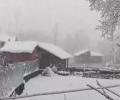
Fresh snowfall in Kashmir, including Srinagar, leads to flight cancellations and highway closures, disrupting normal life.

A severe cold wave has gripped North India, with temperatures plummeting to near-freezing levels in several areas. The cold wave has disrupted daily life, with dense fog affecting visibility and forcing people to stay indoors.

A new western disturbance brought thunderstorms and rain to parts of northern India, with hailstorms and snow reported in several regions. The weather caused flooding in Jammu and Kashmir and prompted a yellow alert in Delhi.

The national capital was in the grip of a cold wave, with the sun largely obscured by clouds and pollutants lingering in the atmosphere, leading to reduced visibility. At least 129 flights were cancelled at the Delhi airport on Saturday due to dense fog, according to an official.

Delhi recorded its coldest January morning in three years with the minimum temperature dropping to 3 degrees Celsius. Cold wave conditions are expected to persist, and air quality has deteriorated to the 'very poor' category.

A severe cold wave has intensified across North India, with Delhi recording its lowest temperature of the season. Rajasthan experienced sub-zero temperatures, and several states have issued alerts and closed schools due to the extreme conditions.

The winters could be cooler in the plains due to the prevailing La Nina conditions though it does not have a direct relationship and also due to influence of the polar vortex.

Heavy rains across India have led to widespread flooding, causing damage to infrastructure, displacement of residents, and disruption of normal life. Rescue efforts are underway in affected areas.

Srinagar recorded the maximum temperature of 35.6 degrees Celsius on Wednesday, the highest temperature in the month of July in 25 years since 1999 when the mercury had settled at 37 degrees Celsius, the officials said.

Relentless heavy rain led to a landslide on the route to the Mata Vaishno Devi shrine atop the Trikuta hill on Tuesday afternoon, killing at least five people and injuring 14, officials said.
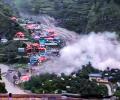
'The lakes up there were already at the brink due to accumulated rainwater, and then snowmelt occurred.' 'When one lake breached, it triggered a cascading effect -- other lakes breached subsequently.'

Strong demand for cultural and spiritual hubs is expected for destinations like Varanasi, Kolkata during Durga Puja, and Pushkar for the camel fair, besides leisure destinations like Goa, Udaipur, Jaipur and Coorg.
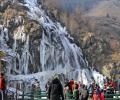
A cold wave has gripped many parts of north and east India, with Srinagar recording a minimum temperature of minus 5.3 degrees Celsius. Other areas experiencing below-freezing temperatures include Gulmarg, Pahalgam, Konibal, Qazigund, Kupwara, and Kokernag in Kashmir. Himachal Pradesh has issued an orange warning for severe cold wave conditions in several districts. Delhi recorded a minimum temperature of 5.9 degrees Celsius, while Faridkot in Punjab was the coldest in the region at 0 degrees Celsius. Extreme cold conditions also continued in parts of Rajasthan and Jharkhand. The Met office has forecast mainly dry weather until December 26, with the possibility of light snowfall in the higher reaches of Kashmir on the intervening night of December 21-22.

According to the Met department, Srinagar recorded 0.4 mm of snowfall till 0830 am.
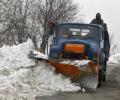
The Srinagar-Jammu national highway, the only all-weather road linking Kashmir to the rest of the country, was closed for vehicular traffic as the valley including Srinagar experienced fresh snowfall on Wednesday.

Satellite imagery showed a layer of dense fog extending from Punjab and north Rajasthan to the northeast. Patches of fog were also visible along the east coast.

Traffic movement has resumed five days after the road was closed in the wake of landslides.

A cold wave has intensified in most parts of north India, with temperatures in the Kashmir Valley dipping below freezing point. The national capital saw a brief respite from the bitter cold during the day, but cold conditions persisted in parts of Rajasthan and Himachal Pradesh. The weather department has issued a yellow warning for cold wave, ground frost and dense fog for some places in Himachal Pradesh. There is a possibility of rain and snowfall in parts of northwest India later in the week.

Delhi saw seven cold wave days in January 2020, while it did not record any such day last year.

Delhi's primary weather station, the Safdarjung Observatory, registered a maximum temperature of 40.4 degrees Celsius, four notches higher than normal.

Painted with pink and neon green, the 'snow car' has been a hit on social media.

The minimum temperature in Srinagar was recorded at a low of minus 0.5 degrees Celsius.

The body of a junior commissioned officer was retrieved from a stream in the Poshana area of Surankote late Saturday evening, while the body of a second soldier was found this morning as the water level started receding in the district.

Fresh snowfall disrupted normal life in Jammu and Kashmir, where an avalanche warning was issued in five districts, higher reaches and tribal areas of Himachal Pradesh and the Garhwal region of Uttarakhand on Monday.

The denizens of Kashmir division experienced bone chilling cold as the night temperature in most places including summer capital Srinagar slipped below the freezing point, compounding the problems of those affected by the recent floods.

On December 7, 1990, Srinagar had recorded a low of minus 8.8 degrees Celsius.

For the fourth consecutive day, Monday, the Srinagar-Jammu National Highway remained closed for traffic in the wake of landslides at some places, even as higher reaches in Kashmir received fresh snowfall overnight.
The cold wave continued unabated in Jammu and Kashmir where Leh, in Ladakh region, was recorded to be the coldest place in the state, while the night temperature in Srinagar remained below the freezing point for the seventh consecutive night, a meteorological department official said in Srinagar.

The Meteorological Department has forecast rains or snow over five days from Monday.

According to the IMD, a rain event is categorised as a cloudburst if a weather station receives 100 mm of rain in one hour.

Large parts of north India reeled under numbing cold on Tuesday with the mercury remaining below freezing point at most places in Jammu and Kashmir, while dense fog in the early hours of the morning hit road and rail traffic movement.

Snowfall brought cheer to many Kashmiris.

The all-time low recorded in the month of December in Srinagar is minus 12.8 degrees Celsius on December 13, 1934.

The minimum temperature across the Kashmir Valley and Ladakh Union Territory stayed several degrees below the freezing point, intensifying the cold wave in some areas in the region, an official of the Meteorological Department said. He said Srinagar city recorded the low of minus 6.2 degrees Celsius last night, down from minus 5.8 degree Celsius the previous night.
The cold tightened its grip on Jammu and Kashmir as the mercury plummeted by eight degrees in Leh in Ladakh region to register the season's lowest temperature and most parts of the Valley froze in sub-zero temperatures.

Operations at the Delhi airport remained normal. However, three flights were returned or diverted to the Delhi airport due to bad weather in Chandigarh, Varanasi and Lucknow on Tuesday night.
An earthquake of mild intensity rocked Srinagar and adjoining areas early on Thursday, forcing people to rush out of their homes in panic.This was the fifth earthquake of mild intensity to hit Srinagar since February 20. the epicenter of the 3.9 magnitude earthquake was at 34.1 Latitude (North) and 74.6 Longitude (East). There was no report of any loss of life or damage to property, official sources said.

The national capital, parts of which reeled under heatwave conditions for the past few days, had some relief on Wednesday with strong winds and partly cloudy skies witnessed during the day.

This month has been the "wettest" March in northern and central parts of the country in the past 100 years, the Indian Meteorological Department said on Sunday, and predicted more rains in the coming two weeks.
 © 2026 Rediff.com - Advertise with us - Disclaimer - Privacy Policy - Sitemap - Feedback - About us - Terms of use - Grievances